
 Author
Osman Basaad
Business & Entrepreneurship Writer
Osman Basaad writes about business,
entrepreneurship, startups, innovation
and technology, focusing on clear,
practical and useful information for
modern entrepreneurs and business readers.
Author
Osman Basaad
Business & Entrepreneurship Writer
Osman Basaad writes about business,
entrepreneurship, startups, innovation
and technology, focusing on clear,
practical and useful information for
modern entrepreneurs and business readers.
 Content Reviewer
Inzemam Ul Haq
SEO, Digital Marketing &
Business Development Professional
Inzemam Ul Haq is a Content Reviewer
with 5+ years of experience in SEO,
digital marketing and business development.
He reviews content for clarity, relevance
and usefulness for readers.
Content Reviewer
Inzemam Ul Haq
SEO, Digital Marketing &
Business Development Professional
Inzemam Ul Haq is a Content Reviewer
with 5+ years of experience in SEO,
digital marketing and business development.
He reviews content for clarity, relevance
and usefulness for readers.
Last Updated: October 7, 2026
Significant changes in the operation of modern companies occur due to technology. Artificial intelligence, cloud computing, automation, cybersecurity, and data analytics are not the technologies of the IT industry only anymore. Many industries, from finance to health care, retail, manufacturing, logistics, and professional services, employ digital technologies in order to operate more efficiently and make better decisions.
Now, let us talk about Droven.io enterprise technology innovations. This is the platform that can be called the editorial platform for artificial intelligence, emerging technologies, software development, digital transformation, innovation, and the future of work. It covers AI, machine learning, generative AI, robotics, startups, development, and future technology.
Why is it important for entrepreneurs and business leaders to know such technologies? Of course, we are not talking about the adoption of all possible innovations. We need to find those that will help solve certain problems and provide value to companies.
Table of Contents
What is Droven.io Enterprise Technology Innovations?
It is possible to say that the concept of Droven.io enterprise technology innovation is the unification of topics covered by this platform and enterprise technology innovation.
As we have stated above, Droven.io is not enterprise software but a content and knowledge platform. The content of the platform covers artificial intelligence, automation, emerging technology, startups, software development, and digital transformation.
Enterprise technology innovation is the employment of modern technologies by companies in order to improve products, services, processes, and decision-making.
The key topics covered are the following:
- Artificial intelligence
- Workflow automation
- Cloud computing
- Data analytics
- Cybersecurity
- Software development
- Digital transformation
- Robotics
- Emerging technologies
Very often, these technologies are combined with each other.
For instance, a company may use cloud computing infrastructure for running an AI application, analytics for monitoring its performance, and cybersecurity tools for protecting the data used.
Why Enterprise Technology Innovation Matters
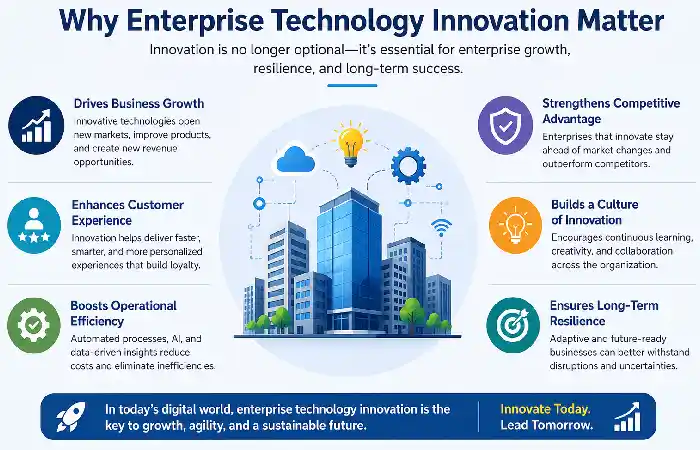
Companies are constantly seeking ways to reduce costs, optimize the customer experience, and react promptly to any change.
Technology can help here.
Correctly implemented digital transformation allows for minimization of redundant actions, better access to data, and provision of employees with tools necessary for prompt decision-making.
However, innovations should not be measured by the number of bought applications.
The question should be asked in the following form:
Does this Technology help to solve a Problem of the Company?
Automation of data entry gives employees several additional hours in a week. The system of artificial intelligence can detect patterns that would be hardly visible otherwise. It is important to focus on the result and not on the fact that some innovative technology is used.
| Company Problem | How Technology Helps | Expected Benefit |
| Slow business processes | Automates repetitive tasks | Saves time and resources |
| Poor communication | Connects teams through digital tools | Improves collaboration |
| Data management issues | Stores and organizes data efficiently | Better decision-making |
| High operating costs | Reduces manual work and errors | Lowers expenses |
| Customer service challenges | Provides faster support and self-service options | Improves customer satisfaction |
| Limited productivity | Streamlines workflows and tasks | Increases employee productivity |
Artificial Intelligence and Enterprise Innovation
Artificial intelligence is one of the key areas of enterprise technology.
AI can be applied for:
- Customer support
- Document processing
- Data analysis
- Software development
- Marketing
- Fraud detection
- Forecasting
- Internal knowledge search
- Workflow automation
Droven.io deals with the following issues in connection with AI: generative AI, machine learning, AI tools, applications, and automation.
Generative AI
Generative AI creates or transforms text, images, code, or other types of information.
In terms of business, the possible applications of generative AI are as follows:
- Drafting documents
- Summarizing meetings
- Creating marketing materials
- Aiding developers
- Searching internal knowledge
- Creating the first draft of reports
At the same time, companies should consider such problems as accuracy, privacy, intellectual property, and human supervision.
AI-generated information cannot be taken for granted only because it looks plausible.
Automation and Business Efficiency
Automation is another area of enterprise innovation. Classic automation presupposes a strict and predetermined set of rules. Innovative automation systems can use AI to deal with more complicated situations.
Let us take the example of the workflow in the sphere of customer support.
Such a system can do the following:
- Accept the customer request.
- Define its subject.
- Classify the request.
- Find necessary information.
- Suggest the response.
- Forward complicated requests to an employee.
- Maintain the record of the case.
Thus, it becomes possible to get rid of routine work and keep the human part in case it is necessary.
Generally, the most successful automation projects start with a well-defined process.
Cloud Computing and Enterprise Transformation
The introduction of cloud computing transformed the way that enterprises developed and operated digital services. They could employ cloud infrastructure to develop their computing, storage, databases, applications, and other services.
Businesses can better understand this shift by exploring the relationship between enterprise platforms and the cloud, including how enterprise systems increasingly use cloud-based infrastructure.
By adopting cloud computing, enterprises could gain the following:
- Flexible infrastructure
- Accessibility from any place
- Quick deployment
- Scalable computing capabilities
- Easy collaboration
- Access to modern development tools
However, cloud systems have their challenges related to security, costs, data governance, and access management.
It is unreasonable to move everything to the cloud without architecture. Enterprises need to establish which workloads require cloud computing.
Data Analytics and Improved Decision-making
Technology generates a tremendous volume of business data.
The sales transactions, customer communications, website activity, inventory, operational data, and financial information may all yield valuable insights.
Data analytics enables the enterprise to extract useful information from the mentioned sources.
Businesses and professionals working with enterprise data can also explore these top data science techniques to better understand how data can be analyzed and used for decision-making.
For instance, data analytics can help determine such things as:
- What products are more popular?
- When do the customers communicate the most?
- Where do operational issues happen?
- What marketing campaigns generate leads?
- Who will quit as clients?
- Where do costs arise?
The quality of the answers depends much on the quality of data used as a source.
Any complex analytics platform will not help in case of inaccurate, inadequate, and ill-structured information.
Cybersecurity and Enterprise Innovation
Innovation without cybersecurity creates more dangers.
Since enterprises utilize cloud platforms, AI technologies, remote access, API services, and connected applications, the number of protected systems becomes higher.
Therefore, cybersecurity needs to be planned together with technological innovations.
Important areas include:
| Security Area | Purpose |
| Identity management | Controls who can access systems |
| Multi-factor authentication | Adds another layer of account protection |
| Encryption | Helps protect sensitive information |
| Access controls | Limits unnecessary permissions |
| Backups | Supports recovery after data loss |
| Monitoring | Helps identify suspicious activity |
| Employee training | Reduces risks from human error |
Depending on the particular business, size, industry, technology stack used, and regulatory requirements, the exact security controls that are needed might be different.
Digital Transformation Beyond Software
Digital transformation does not consist solely of software purchase.
It may imply changing an existing business model.
For instance, replacing paper forms with the use of digital tools means that a business has implemented a new tool. However, designing a completely new approval process based on digital workflows implies a much bigger operational change.
Some key components of digital transformation include:
- People
- Process
- Technology
- Data
- Leadership
- Organizational culture
Employees should be able to understand what changes are going to happen and why.
If there is no adoption of a new technology, the most advanced tool will be useless.
Enterprise Technology Innovation: Key Advantages
There are some potential advantages that organizations can benefit from after the proper use of innovative technology.
Increased Efficiency
Automation can reduce administrative burdens and give employees more time to engage in high-value work.
Faster Decision Making
Analytics and real-time data can facilitate decision-making.
Improved Customer Experience
The use of digital technologies can improve purchasing, communications, support, and account management services.
Increased Scalability
Cloud and software platforms can help businesses grow without having to recreate each system.
New Business Models and Possibilities
Emerging technologies may provide new products and services.
Common Pitfalls
Innovation in enterprises can also be accompanied by certain pitfalls.
High Implementation Costs
Innovative projects can require spending considerable amounts of money on software, infrastructure, consulting services, training, and maintenance.
Resistance from Employees
People tend to resist any innovation they don’t understand or find threatening to their jobs.
Integration Issues
A new platform might not integrate well with existing software.
Security Risks
Improper implementation and configuration of systems may lead to the exposure of private information or an increase in attack surfaces.
Unclear Objectives
Projects related to innovative technology may fail because of unclear project objectives.
How Businesses Can Approach Technology Innovation
Here are the steps involved in taking a practical approach.
Step 1: Define a Problem
Think about the business problem, not about the technological trend.
For example:
“Our customer service team wastes lots of time dealing with the same repetitive questions.”
It is better than:
“We should implement AI here.”
↓
Step 2: Define Improvement
Think about how it can be improved to justify the project value.
For example, an improvement can include:
- Lower operational costs
- Improved speed of action
- Higher customer satisfaction level
- Less manual work required
- Better prediction abilities
↓
Step 3: Compare the Technologies
Do not just grab the hottest one, but think about the aspects of each option.
They can include functionality, cost, integration, security, scalability, and support.
When evaluating technology options, businesses can also consider Droven.io IT services in the USA as a reference for understanding modern IT services and technology solutions.
↓
Step 4: Do Pilot Testing
This step helps to catch possible issues before a company wastes too much effort.
↓
Step 5: Analyze Results
Define the metrics that show whether the technology adds any value.
↓
Step 6: Implement Technology Gradually
If pilot testing was successful, go step-by-step and monitor the process.
Enterprise Innovation and Startups
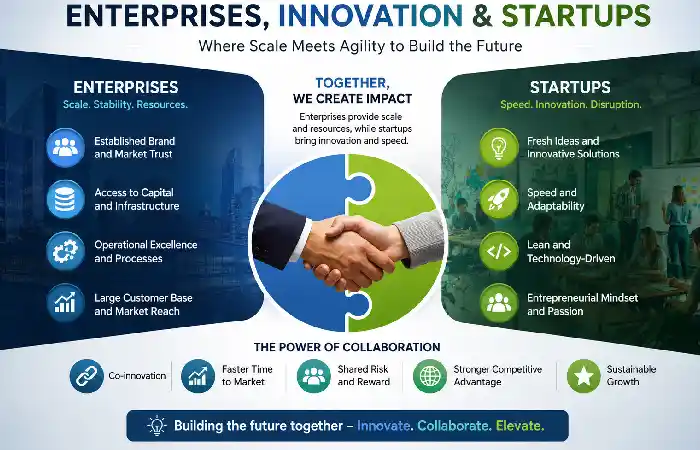
Startups can be more agile than big corporations since they lack legacy systems and organizational layers.
One of the spheres covered by Droven.io technology is startups.
Thanks to emerging technology, startups can develop products based on problems that were ignored by large companies.
On the other hand, enterprises have some advantages – they have their customers, more data, field experience, and more resources.
That is why there are opportunities for collaboration between startups and enterprises.
Future Enterprise Technology Trends
The sphere of enterprise technology is going to change.
Some areas of development are:
- Generative AI
- AI agents
- Robots
- Quantum computing
- Cloud-native applications
- Cybersecurity automation
- Advanced analytics
- Edge computing
- Digital twins
- Intelligent workflow systems
Droven.io covers the spheres of technology, including future technology, robotics, startups, and emerging AI.
Enterprise Tech Innovation Comparison
| Technology | Main Business Use | Potential Benefit |
| AI | Analysis, prediction, assistance | Faster and smarter workflows |
| Generative AI | Content and knowledge tasks | Productivity improvements |
| Automation | Repetitive processes | Reduced manual work |
| Cloud computing | Infrastructure and applications | Scalability and flexibility |
| Data analytics | Business intelligence | Better decisions |
| Cybersecurity | Risk protection | Stronger digital resilience |
| Robotics | Physical automation | Operational efficiency |
Conclusion
Innovation of enterprise technology in Droven.io can be considered a technology-oriented issue as it concerns the use of AI, automation, cloud computing, analysis, cybersecurity, and new technologies for improving business processes. Not always is the best technology-oriented strategy the one that involves the use of any solution at the earliest stage possible.
What really matters is when technology is connected with the business needs. The entrepreneur and the owner of a business should take care of the following steps: identifying problems, selecting the right technology, engaging employees, protecting the business data, and measuring the outcomes.
The rate of technological change will be increasing. Business enterprises will find it much easier to handle these issues if they master the skill of assessing and implementing innovations.